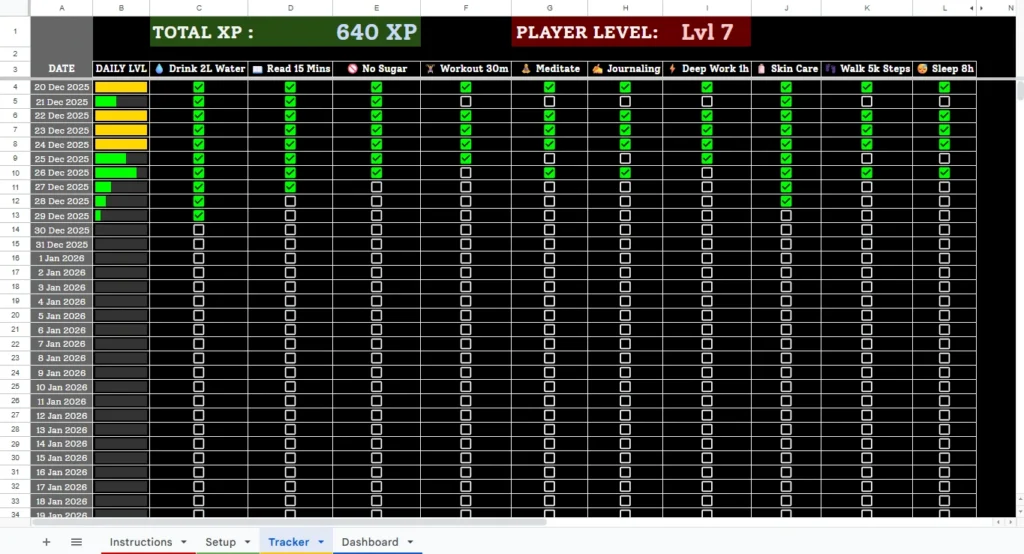
Gamify Your Habits: The Ultimate “Perfect 10” System
 VR Team
- January 1, 2026

We have all been there. It’s 11 PM, you are exhausted, and you realize you haven’t done half the things you promised yourself you would do this morning. You feel a pang of guilt, you promise to “try harder” tomorrow, and the cycle repeats. It is time to stop struggling and learn how to gamify your habits.
We often treat self-discipline like a punishment. We assume that if we aren’t suffering, we aren’t growing. But consider this: Why can a person who struggles to focus for 20 minutes on a spreadsheet spend four hours grinding through a difficult level in a video game? The task in the game is often repetitive, frustrating, and difficult, yet they do it willingly.
The difference isn’t laziness; it is feedback loops.
Video games are masters of engagement because they provide immediate, visual feedback for every action. Real life, unfortunately, lags. If you eat a salad today, you won’t look different tomorrow. If you read for 30 minutes, you won’t feel smarter instantly. Because the reward is invisible, the brain loses interest.
To hack this biological loophole, we need to stop making “to-do lists” and start building a system to gamify your habits properly.
Why Gamify Your Habits? The Science of the Progress Bar
Human beings are teleological—we are goal-oriented. But we are also highly sensitive to visual completion. This is rooted in the Zeigarnik Effect, a psychological phenomenon where incomplete tasks create mental tension, and completing them releases dopamine.
A standard checklist is binary: Done or Not Done. It’s functional, but it’s emotionally flat.
A strategy to gamify your habits changes the metric. Instead of a chore, a habit becomes “Experience Points” (XP). When you visualize your day as a bar filling up from 0% to 100%, you are no longer just “doing laundry” or “drinking water”; you are leveling up.
This seemingly small shift engages the brain’s reward center before the long-term results actually kick in. You get the dopamine hit from the progress bar today, which sustains you until the real results arrive months later.
The Rule of 10: Why "More" is the Enemy
When people start tracking habits, they usually make a fatal mistake: Bloat.
They try to track 25 different things: Floss, walk the dog, take vitamins, call mom, stand up straight, drink tea, study Spanish, fix posture…
Psychologically, this is a disaster. It creates what is known as Decision Fatigue. Every time you look at a list of 25 items, your brain has to process 25 micro-decisions. Eventually, your willpower battery drains, and you quit the entire system.
This is why the most effective way to gamify your habits is to rely on a capped number of “Daily Quests”—specifically, The Perfect 10.
Limiting your “Daily Quest Log” to exactly 10 items is strategic:
- Cognitive Load: According to Miller’s Law, the average human can hold about 7 (plus or minus 2) objects in their working memory. Ten is just enough to push you, but not enough to break you.
- The Scoreboard Effect: Ten is a mathematically satisfying number. If you hit 5 habits, you know instantly you are at 50%. If you hit 8, you have an 80% grade. That missing 20% creates a psychological “itch” that drives you to finish the last two tasks just to see the “100%” notification.
- Forced Prioritization: If you only have 10 slots, you cannot fill them with fluff. You have to choose the 10 things that actually move the needle for your life.
Designing Your Character: The "Balanced Build"
In RPGs (Role Playing Games), you never put all your points into just one stat. If you build a character with high Strength but zero Intelligence or Health, you lose the game.
Life works the same way. The “Hustle Culture” approach often encourages a “Glass Cannon” build: 100% productivity, 0% mental health. You might get a lot of work done, but you eventually burn out and crash.
When you gamify your habits using the ‘Perfect 10’ system, it forces you to diversify your stats. To run well, your 10 habits should be distributed across these core attributes:
- Mana (Mental Clarity): Habits like meditation, journaling, or digital detox periods. These regenerate your ability to focus.
- HP (Vitality): The physical basics. Hydration (2L), Clean Eating, 7+ hours of Sleep, and Movement. If your HP drops to zero, the game is over.
- Intellect (Growth): Reading non-fiction, learning a language, or studying a new skill. This is how you upgrade your character over time.
- Main Quest (Output): This is your Deep Work. The single most important task (MIT) you need to complete today to advance the plot of your life.
When you view a glass of water not as a chore, but as a “+10 HP Potion,” you are far more likely to drink it. When you view sleep not as “wasting time” but as “Restoring Mana,” you prioritize it.
The "Combo Breaker" Fear
The final component of a good system is resilience. Traditional habit trackers are fragile; if you break a 50-day streak, you feel devastated and often quit entirely. This is the “What the Hell” effect—where one slip-up leads to total abandonment.
The decision to gamify your habits fixes this by focusing on the Daily High Score.
Did you miss yesterday? That’s fine. Yesterday’s level is closed. Today is a new level with a fresh score of 0/10 waiting to be filled. You don’t lose your progress because you are building a “Total XP” lifetime score, not just a fragile chain of days.
Conclusion
Discipline doesn’t have to be a grind, and productivity doesn’t have to be boring. By applying game mechanics—scoring, visual progress, and capped quests—you can trick your brain into enjoying the difficult things.
You don’t need to gamify your habits with more willpower; you just need a better game to play.
 Ready to start your run? We have translated this entire psychological framework into a digital tool. Stop building lists and start playing your life with the Daily Habit Tracker. Pre-loaded with the 10 essential habits, balanced scoring, and progress tracking.